


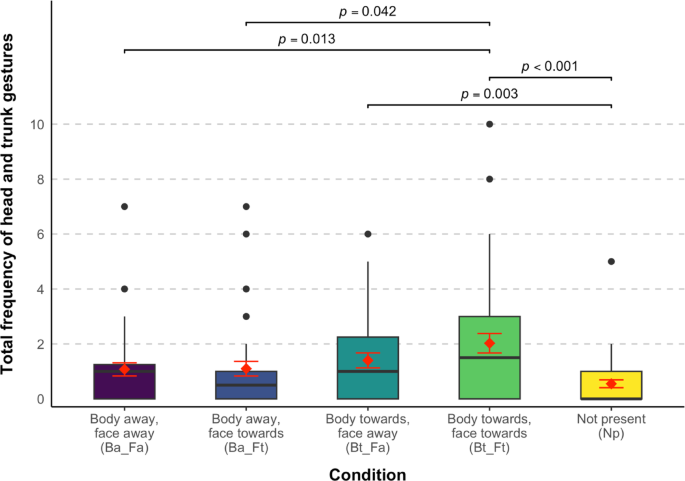
Our hypotheses, predictions, study design, and the behavioural and statistical analysis plan were pre-registered ( We made two deviations from this: the elephants were tested in four sessions instead of two, and we modified Smet and Byrne’s 19 ethogram.
Ethics declaration
This study was approved by the National Research Council of Thailand (Protocol #0401/95). Ethical approval was obtained from the Faculty of Veterinary Medicine’s Animal Care and Use Committee (Protocol #R23/2566) at Chiang Mai University and the Wildlife Research Center’s Ethical Committee (Protocol #WRC-2023-009A) at Kyoto University. All methods were performed in accordance with the relevant guidelines and regulations, and this study is reported in accordance with ARRIVE guidelines. The elephants’ participation was voluntary, and the mahout (caretaker) could stop the experiment at any time if he felt the elephant did not want to participate anymore, but this never happened.
Participants
Ten captive female Asian elephants (Elephas maximus) aged 11–61 (M = 36.8, SD = 17.16) from the Golden Triangle Asian Elephant Foundation living on the properties of the Anantara Golden Triangle Elephant Camp and Resort in Chiang Rai, Thailand, participated in the experiment between February and March 2024 (see Table S3).
Experimental design
Each elephant was tested in four sessions conducted on separate days using a within-subjects, repeated-measures design. There was a 2-day break between sessions 1 and 2, a 6-day break between sessions 2 and 3, and a 2-day break between sessions 3 and 4.
In each session, the elephant completed one trial of each of the following conditions, which varied the orientation of the experimenter’s body and head, in a randomised order (Fig. 2):
-
1.
Body away, face away (Ba_Fa)
-
2.
Body away, face towards (Ba_Ft)
-
3.
Body towards, face away (Bt_Fa)
-
4.
Body towards, face towards (Bt_Ft)
-
5.
Not present (Np)—henceforth ‘baseline’


Experimental conditions showing the different orientations of the experimenter’s body and head, and the baseline condition. Illustrations by Hoi-Lam Jim.
We did not include the ‘body sideways’ conditions tested in Smet and Byrne 19 due to time constraints.
Experimental setup
The experiment was conducted in a large field at the Anantara Golden Triangle Elephant Camp and Resort. The testing area (10.6 m [W] × 21.5 m [L]) was mowed, with tall grass surrounding the perimeter. A volleyball net (4.7 m [W] × 1.2 m [H]) was strung across the centre of the field, and a holding pen (2 m [W] × 3.7 m [L]) made of bamboo was built 35 cm behind the net to position the elephants during the experiment. The front and sides of the holding pen were covered with a volleyball net, while the back was left open so the elephant could exit freely. The experimenter (H.-L.J.; ‘E’) used a wooden tray (50 cm × 50 cm, with 1 m long handles) to feed the elephant during the experiment.
The whole experiment was recorded by two GoPro Hero 10 Black cameras. The side view camera was placed on a tripod at the side of the testing area and the front view camera was placed on a tripod close to E, facing the participant (Fig. 3).


Schematic depiction of the experimental setup.
Procedure
Wild grasses were available ad libitum outside experiment times, and the elephants were additionally fed according to their regular feeding regimes; thus, they were not food-deprived before the experiment. Mangoes, a high-value food reward for elephants, were cut into half-pieces and used as the food reward. Each elephant was accompanied by her own mahout, who stood behind her during the experiment to avoid influencing her behaviour. However, there was one exception to this: due to the potential danger of working with one elephant (Yuki), her mahout wore sunglasses and initially stood to the side of her with his back towards E, so he was unaware of E’s posture. Once the mahout felt that Yuki was comfortable and the situation was safe, he moved to stand behind her. Throughout the experiment, the mahout only spoke to give commands, such as instructing the elephant to take the food if she did not reach for it when offered, or to stop if she physically interacted with the holding pen or volleyball net, or attempted to walk around the pen to retrieve the food.
Prior to testing, the elephant could explore the environment freely for approximately five minutes to familiarise herself with the location and the holding pen. Each mahout tested how far his elephant could reach with her trunk inside the holding pen, which ranged from 2.35–3.5 m, and the distance was marked by placing a rope on the ground. The tray was placed behind the rope; thus, the elephant supposedly could not reach the food. However, there were two occasions where the elephant managed to retrieve the food herself: one elephant (Jathong) pushed forward inside the holding pen, grabbed the tray, and pulled it towards herself; another elephant (Bo) retreated from the holding pen and walked around the volleyball net to eat from the tray and her mahout could not stop her in time. Both incidents occurred during the baseline after the test trial ended, thus the data were not excluded from analysis.
The experiment generally followed the procedure outlined in Smet and Byrne 19. All elephants were tested individually between 7:30 and 9 am or 2 and 3 pm depending on their availability, and each session took approximately 10 min. A session began with three ‘no-delay’ trials: E stood behind a wooden tray, called the elephant’s name whilst facing her, and placed a piece of food onto the tray. E then immediately picked up the tray and moved forward to allow the elephant to eat from the tray. After the elephant took the food, E placed the tray down in its original position. If the elephant did not take the food from the tray voluntarily in the first ‘no-delay’ trial because she was afraid of touching the volleyball net, the mahout showed the elephant the food and encouraged her to take it from the tray, and then another ‘no-delay’ trial was conducted to ensure the elephant was comfortable with taking the food from the tray by herself. Elephants also had additional ‘no-delay’ trials during the experiment if a brief interruption or minor experimental mistake occurred. After three consecutive ‘no-delay’ trials, the testing phase began with the first test trial.
In the test trial, E stood behind the tray, called the elephant’s name, placed the food on the tray, picked it up to show it to the elephant, and put it down without giving the food. Then, E adopted one of the four postures (or walked away in the baseline), started the stopwatch, and stood still for 20 s (i.e., the test trial period) before picking the tray up again and moving forward to feed the participant. In the baseline, E started the stopwatch as she turned to walk quickly to the tall grass and hid behind it; thus, she was obscured from the elephant’s view and ‘not present’. After 20 s passed, E walked back to her starting position and moved the tray within the elephant’s reach (see Video S2). Each test trial alternated with a ‘no-delay’ trial and sessions always ended with a ‘no-delay’ trial (see Fig. S1 for a flowchart of the procedure).
Behavioural analysis
We coded the elephants’ actions towards E and the food during the test trial from the footage from the camera facing the elephant, and we supplemented it with the side view video footage when necessary.
We coded the frequency of head and trunk gestures produced to request food based on Smet and Byrne’s 19 ethogram. Some modifications were made because the elephants performed trained begging behaviours not observed in the previous study, and we refined the definitions by introducing subcodes (Table 1). Each behaviour was coded as a single event (i.e., if a behaviour was performed three times consecutively, it was coded as three separate behaviours).
Statistical analysis
All statistical analyses were conducted using R (v4.4.1, 36) in RStudio (v2024.04.2 + 764, 37). The alpha level was set at 0.05 for all statistical tests. H.-L.J. and a research assistant independently coded 20% of the videos (10% from sessions 1 and 2 and 10% from sessions 3 and 4), which were randomly selected. Both coders were blind to the condition in each test trial. Interobserver reliability was assessed using the Intraclass Correlation Coefficient (ICC) from the irr package (v0.84.1, 38), which showed good inter-rater agreement 39: ICC (two-way, agreement) = 0.88, F = 15.4, p < 0.001. H.-L.J. coded the remaining videos blind to the condition in each trial.
Following the pre-registered analysis plan, we fitted a Generalised Linear Mixed-Effects Model (GLMM) using the glmmTMB package (v1.1.9, 40). Due to limited data for individual behaviours, we combined all behaviours and used the total frequency of head and trunk gestures in response to E’s visual attention as the response variable. The test predictor was ‘condition’ (a factor with five levels), with ‘session’ and ‘trial’ included as z-transformed continuous covariates. Participant ID was included as a random effect. The dataset comprised 200 observations from 10 individuals, with 92 instances of no recorded behaviours. As 46% of the data were zeros, we applied a zero-inflated Poisson GLMM.
To avoid multiple testing 41 and maintain type I error rate at the nominal level of 0.05, we compared the full model with a null model lacking the test predictor (‘condition’) using a likelihood ratio test (anova function with method = “Chisq”; 42). Pairwise comparisons with Tukey correction were conducted using the emmeans package (v1.10.2 43). The plot (Fig. 1) was generated using ggplot2 (v3.5.1 44), with significance brackets added using ggsignif (v0.6.4 45) and colours adjusted using viridis (v0.6.5 46).
We assessed model diagnostics as follows: collinearity was evaluated by computing Variance Inflation Factors (VIF) 47 for a standard linear model using the vif function in the car package (v3.1.2, 48), which indicated no issues (maximum VIF = 1.014). Model stability was examined by comparing estimates from the full model with those obtained by systematically excluding each level of the random effect, one at a time. This indicated the model to be stable (see Table S1, for the estimate ranges). Confidence intervals were computed using the boot.glmmTMB function. The model was not overdispersed (dispersion parameter = 1.147). R functions used for assessing model stability, confidence intervals and overdispersion were provided by Mundry 49.
link