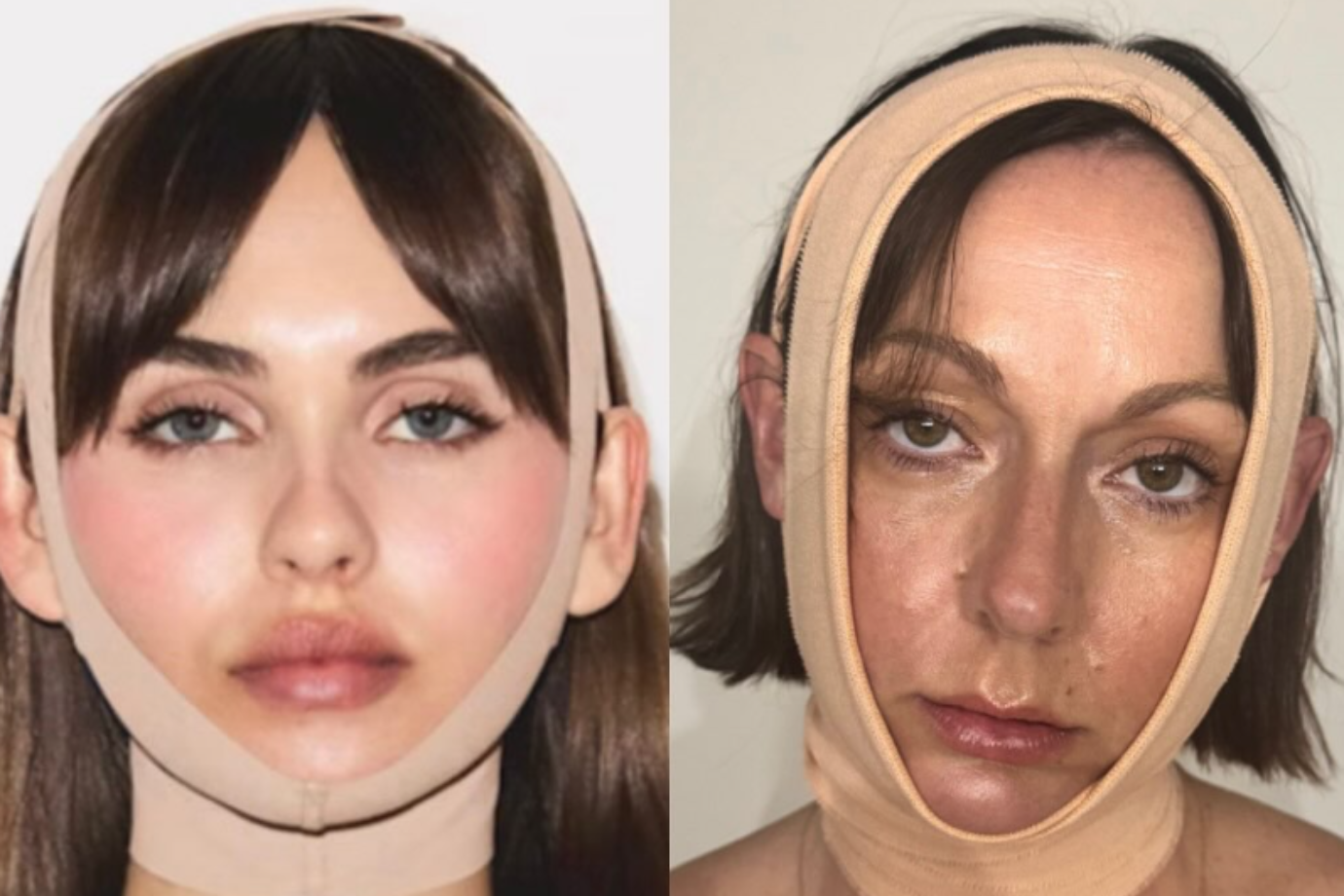
Celeste Barber has long been the internet’s comedic conscience, spoofing celebrity excess with a wink and a dose of reality. But her recent Instagram post mocking Kim Kardashian’s latest SKIMS product, a face wrap designed to sculpt your jawline while you sleep, hit a little deeper.
“SKIMS,” she wrote, “a company so successful at making us hate our body, they’ve now moved onto our face.” It was satire, yes, but also a gut punch for women like me who’ve spent a lifetime scrutinising our bodies, trying to meet standards that shift like sand.
The product in question, SKIMS’ “Ultimate Face Wrap,” is marketed as a collagen-infused, sculpting headpiece meant to “snatch your chinny chin chin” while you sleep. It sold out within hours of launch, despite widespread backlash.
Social media users compared it to Hannibal Lecter’s muzzle and questioned whether it was a joke. One viral comment summed up the sentiment: “SKIMS—making women feel bad about themselves since 2018”. This isn’t just about one product. It’s about a cultural regression. As someone who came of age in the 1990s, I’m watching beauty standards slide backward, back to the era of heroin chic, when Kate Moss’s waif-like frame was the ideal and “nothing tastes as good as skinny feels” was gospel.
Today, social media is flooded with women plucking, lasering, injecting, and contouring themselves into a version of “natural beauty” that’s anything but. Even going to the gym now seems to require a full glam routine. What happened to tying your hair back, throwing on track pants, and sweating unapologetically? The body positivity movement that once championed diverse shapes and self-love feels like a distant memory. In its place is a new tyranny not just of thinness, but of youth, symmetry, and flawlessness.
And it’s not just our bodies under siege, it’s also our faces. The rise of facial shapewear, jawline contouring, and anti-aging filters has ushered in a new era of face shaming. Women are being told that aging naturally is a problem to be solved, not a process to be embraced.
Pamela Anderson is one of the few public figures pushing back. At 56, she’s chosen to go makeup-free, even on red carpets and at Paris Fashion Week. Her decision was deeply personal. She stopped wearing makeup after losing her longtime makeup artist Alexis Vogel to breast cancer in 2019. “Without Alexis,” she said, “it’s just better for me not to wear makeup”. Her bare-faced appearances have sparked praise and reflection, reminding us that beauty can be authentic, not manufactured.
Contrast that with the treatment of Jennifer Love Hewitt, who recently returned to the spotlight for the reboot of I Know What You Did Last Summer. At 46, a mother of three, she was body-shamed online for daring to look her age. The same woman who was called “fat” by magazines in 2007—while wearing a size 2 (Australian size 4)—is now being ridiculed for not resembling her 18-year-old self. Her male co-stars, meanwhile, age into “silver fox” status without scrutiny.
This double standard is exhausting. Brad Pitt and George Clooney are celebrated for aging gracefully. Women, on the other hand, are expected to defy time, gravity, and biology. We’re told to erase wrinkles, lift cheeks, plump lips, and stay forever young or risk being labelled “unhealthy,” “unattractive,” or “past our prime.”
SKIMS, despite its claims of inclusivity, has become emblematic of this pressure. Founded in 2019 by Kim Kardashian, the brand was originally named “Kimono”—a move that sparked backlash for cultural appropriation and led to a rebrand. Since then, SKIMS has grown into a billion-dollar empire, selling everything from waist clinchers to padded shorts to now, facial shapewear. Its marketing leans heavily on celebrity endorsements and aspirational aesthetics, often reinforcing narrow ideals of beauty.
We need to ask, when will these impossible standards dissipate? When will we stop measuring women against their younger selves, or against digitally altered versions of reality? When will aging be seen not as a failure, but as a privilege? A privilege not everyone gets.
Women should be allowed to age however they choose, whether that means embracing wrinkles or opting for cosmetic enhancements. But that choice must be free from shame, judgment, and coercion. It must be ours.
Celeste Barber’s parody wasn’t just funny, it was a mirror. And what it reflected was a culture still obsessed with perfection, still afraid of aging, and still too willing to profit from our insecurities. It’s time to change the reflection.
Become a Women’s Agenda Foundation member and support our work! We are 100% independent and women-owned. Every day, we cover the news from a women’s perspective, advocating for women’s safety, economic security, health and opportunities. Foundation memberships are currently just $5 a month.
Bonus: you’ll receive our weekly editor’s wrap of the key stories to know every Saturday.
Become a member here.
link